The federal government's new Cheaper Home Batteries Program starts July 1st with $2.3 billion in funding. Here's what you need to know to take advantage of these substantial savings.
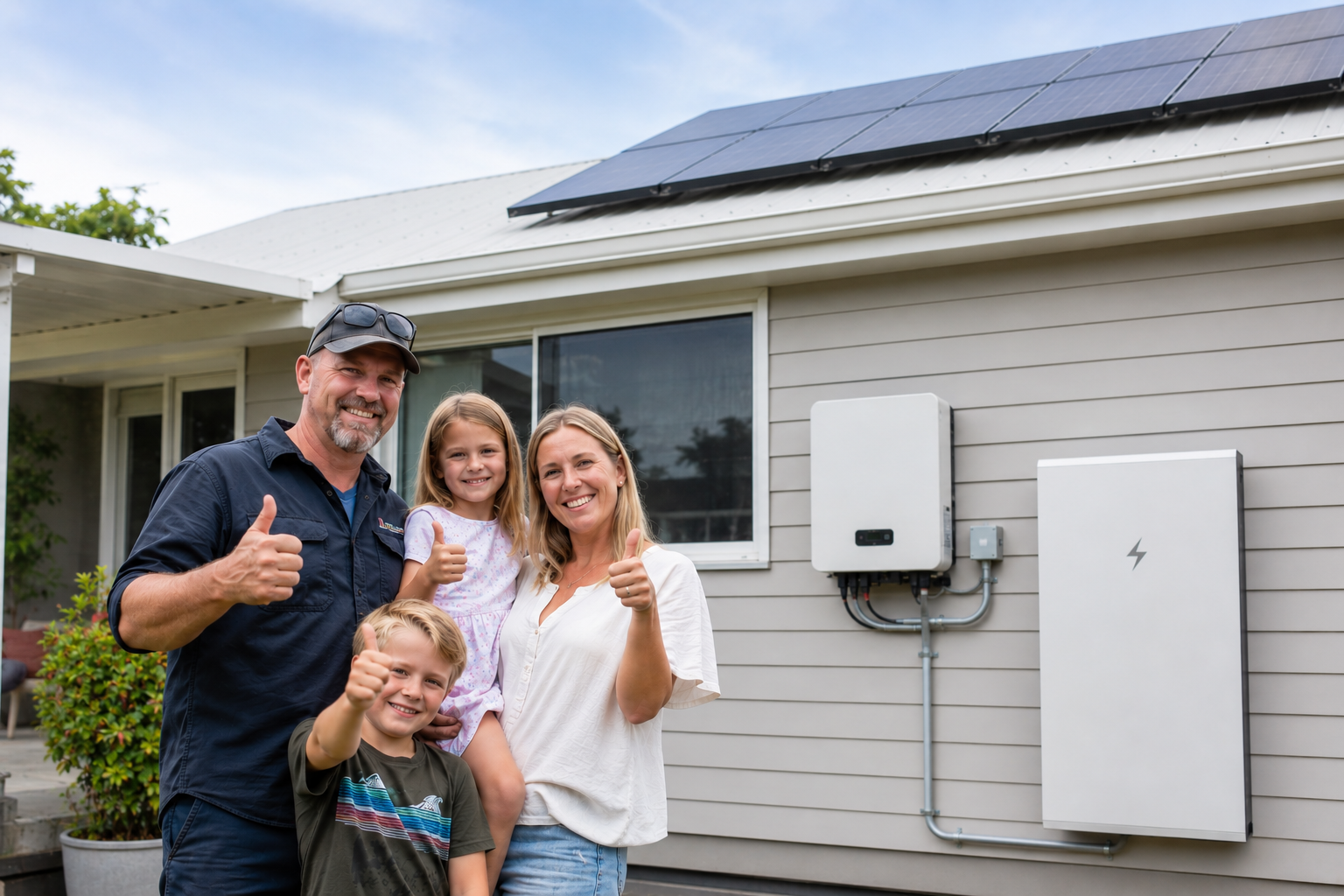 Australian family happy about new battery scheme.
- What is the Cheaper Home Batteries Program?
- How much could you save?
- Detailed eligibility requirements
- On-grid vs off-grid systems
- VPP capability requirements
- Important dates and deadlines
- How it works with existing state rebates
- Installation and safety requirements
- Tips to maximize your savings
Article Contents
Program Overview
How the Rebate Works
Eligibility Requirements
Battery System Requirements
Installation Requirements
Combining with State Rebates
Installation Timing Considerations
Consumer Protections
Article Summary
Cheaper Home Batteries Program
The Cheaper Home Batteries Program is a federal government initiative backed by $2.3 billion in funding. Starting July 1st, 2025, the program provides an upfront discount on the purchase and installation of home battery systems across Australia, delivered through the Small-scale Renewable Energy Scheme (SRES) administered by the Clean Energy Regulator.
The program aims to help households make the most of cheap and clean solar power by storing it for when it's needed, while reducing costs for everyone through less expensive gas power generation and reduced strain on poles and wires infrastructure.
The rebate provides around a 30% discount on the upfront cost of installing eligible small-scale battery systems, with the discount gradually decreasing until the program ends in 2030.
Important Program Details
- Total funding: $2.3 billion
- Official start date: July 1st, 2025
- Program end: December 31st, 2030
- Intended discount: Around 30% off battery system costs
- Delivery method: Through the Small-scale Renewable Energy Scheme (SRES)
- Administration: Clean Energy Regulator
How the Rebate Works
The rebate works through the creation of Small-scale Technology Certificates (STCs) based on the usable capacity of your battery system. The discount will generally be provided via solar and battery retailers and installers at the point of sale.
Official STC Calculation and Estimated Values
| Year | STC Factor | Estimated Value per kWh | Description |
|---|---|---|---|
| 2025 | 9.3 STCs per kWh | $372 | Maximum rebate year |
| 2026 | 8.4 STCs per kWh | $336 | Reduced rebate |
| 2027 | 7.4 STCs per kWh | $296 | Reduced rebate |
| 2028 | 6.5 STCs per kWh | $260 | Reduced rebate |
| 2029 | 5.6 STCs per kWh | $224 | Reduced rebate |
| 2030 | 4.7 STCs per kWh | $188 | Final year |
*Estimated values based on $40 per STC. Values may vary over time based on market conditions.
Example Rebate Calculations for 2025
| Battery Size (Usable Capacity) | STCs Generated | Estimated Rebate Value |
|---|---|---|
| 5 kWh | 46.5 STCs | $1,860 |
| 10 kWh | 93 STCs | $3,720 |
| 15 kWh | 139.5 STCs | $5,580 |
| 20 kWh | 186 STCs | $7,440 |
| 30 kWh | 279 STCs | $11,160 |
| 50 kWh (Maximum) | 465 STCs | $18,600 |
*STCs only provided for the first 50 kWh of usable capacity. Calculations based on $40 per STC estimate.
Eligibility Requirements
The Cheaper Home Batteries Program is available to a wide range of participants with specific system requirements:
Who Can Apply
- Residential homeowners
- Small businesses
- Community facilities
- No means testing (all income levels eligible)
- One rebate per premises
Capacity Requirements
- Minimum: 5 kWh nominal capacity
- Maximum: 100 kWh nominal capacity
- Rebate cap: 50 kWh of usable capacity
- Single battery unit or modular system
Battery System Requirements
To qualify for the rebate, battery systems must meet several technical and operational requirements:
Essential System Requirements
- Clean Energy Council Approval: Battery system and inverter must be listed on the CEC approved product list
- Solar Connection: Must be installed with existing or new solar PV system
- Australian Standards: Must comply with AS/NZS 5139:2019
- Installation Standard: Must comply with Best Practice Guide: Battery Storage Equipment
On-Grid vs Off-Grid Systems
The program supports both on-grid and off-grid battery installations with different requirements:
On-Grid Systems
- Connected to electricity grid (including National Electricity Market)
- Must be VPP capable
- Requires ongoing internet connection
- Not required to actually join a VPP
Off-Grid Systems
- At least 1km from main grid line OR
- Connection cost exceeds $30,000
- VPP capability not required
- No internet connection requirement
VPP Capability Explained
For on-grid systems, Virtual Power Plant (VPP) capability is mandatory but participation is optional:
- Battery must be able to connect to the electricity grid
- Must respond to signals from third-party VPP operators (such as retailers)
- Requires ongoing internet connection for communication
- Consumers are not required to participate in a VPP
Additional Capacity Rules
If you want to expand your battery system later:
- Additional capacity can be added to existing systems that haven't received a rebate
- Additional capacity must be at least 5 kWh
- Total upgraded capacity cannot exceed 100 kWh nominal
- Important: Additional capacity added to systems that already received a rebate would not be eligible
Installation Requirements
The program has strict installation and safety requirements to ensure quality and safety:
Installer Requirements
- Must be accredited by Solar Accreditation Australia (SAA)
- Installation must be undertaken by or supervised on-site by accredited installer
- Must provide written statements to system owner
Safety & Compliance
- Must comply with state and territory electrical safety regulations
- Certificate of electrical compliance required
- Subject to expanded inspection program
- Must meet jurisdictional regulatory requirements
Combining with State Rebates
One of the most attractive features of the Cheaper Home Batteries Program is that it can be combined with existing state-based battery rebates, allowing for even greater savings:
| State | Available Rebate | Eligible for Combination | Additional Notes |
|---|---|---|---|
| NSW | Peak Demand Reduction Scheme & Battery Rebate | Yes | Subject to state program criteria |
| Victoria | Solar Homes Program | Yes | Subject to state program criteria |
| South Australia | Home Battery Scheme | Yes | Subject to state program criteria |
| ACT | Next Gen Energy Storage | Yes | Subject to state program criteria |
| All States | Various local council incentives | Varies | Check with local authorities |
*State rebate availability and terms are subject to change. Contact Solar Proof for the most up-to-date information for your location.
By combining federal and state rebates, some households could potentially save 40-60% on the total cost of their battery system installation.
Installation Timing Considerations
Understanding the installation timing rules is crucial for maximizing your benefits:
Important Installation Timing
A battery system is considered 'installed' when a certificate of electrical compliance (or equivalent) is signed, confirming the system complies with relevant state and territory electrical safety regulations.
Systems must be installed on or after July 1st, 2025 to be eligible for the rebate.
We anticipate significant demand once the program launches, which could lead to:
- Longer wait times for installations
- Potential price increases due to high demand
- Limited availability of preferred battery models
- Installer scheduling delays
Our recommendation is to start planning now by getting quotes and establishing relationships with reputable SAA-accredited installers.
Consumer Protections and Safety Measures
The program includes comprehensive consumer protections and safety measures:
Written Statements
- Technical details of installation provided
- Confirmation safety requirements were met
- Information on potential energy savings
- Payback period calculations
Inspection Program
- Expanded inspection program for battery installations
- Administered by Clean Energy Regulator
- Enhanced testing requirements under review
- Quality assurance measures
Summary
The $2.3 billion Cheaper Home Batteries Program represents the most significant opportunity for Australians to invest in energy storage technology at a substantially reduced cost. With rebates offering around 30% off battery systems, and the ability to combine with state incentives, there's never been a better time to consider adding a battery to your solar setup.
Key takeaways:
- The program officially starts July 1st, 2025, with $2.3 billion in total funding
- Maximum rebates in 2025: 9.3 STCs per kWh of usable capacity (approximately $372 per kWh)
- Rebate applies to first 50 kWh of usable capacity, with maximum battery size of 100 kWh nominal
- Systems must be CEC approved, installed by SAA-accredited installers, and connected to solar
- On-grid systems must be VPP capable (but participation is optional)
- Off-grid systems have relaxed requirements (no VPP capability needed)
- Can be combined with existing state programs for maximum savings
- Rebate amounts decrease each year until 2030
- Comprehensive consumer protections and safety measures included
- No means testing - available to all households, small businesses, and community facilities
At Solar Proof, we're ready to help you navigate the Cheaper Home Batteries Program and find the best solution for your energy needs. Our team understands all the technical requirements, from VPP capability to installation standards, and can guide you through the process of combining federal and state rebates for maximum savings.
Contact us today to get started on your battery journey and secure your place in line for this exciting new rebate opportunity. With the program's generous funding and decreasing rebate amounts over time, early action will maximize your savings.